
Wall types and materials
Gabion Retaining Walls: Costs, Design and What to Know
How rock-filled basket walls work, published cost references, corrosion and drainage, and what to ask a contractor.
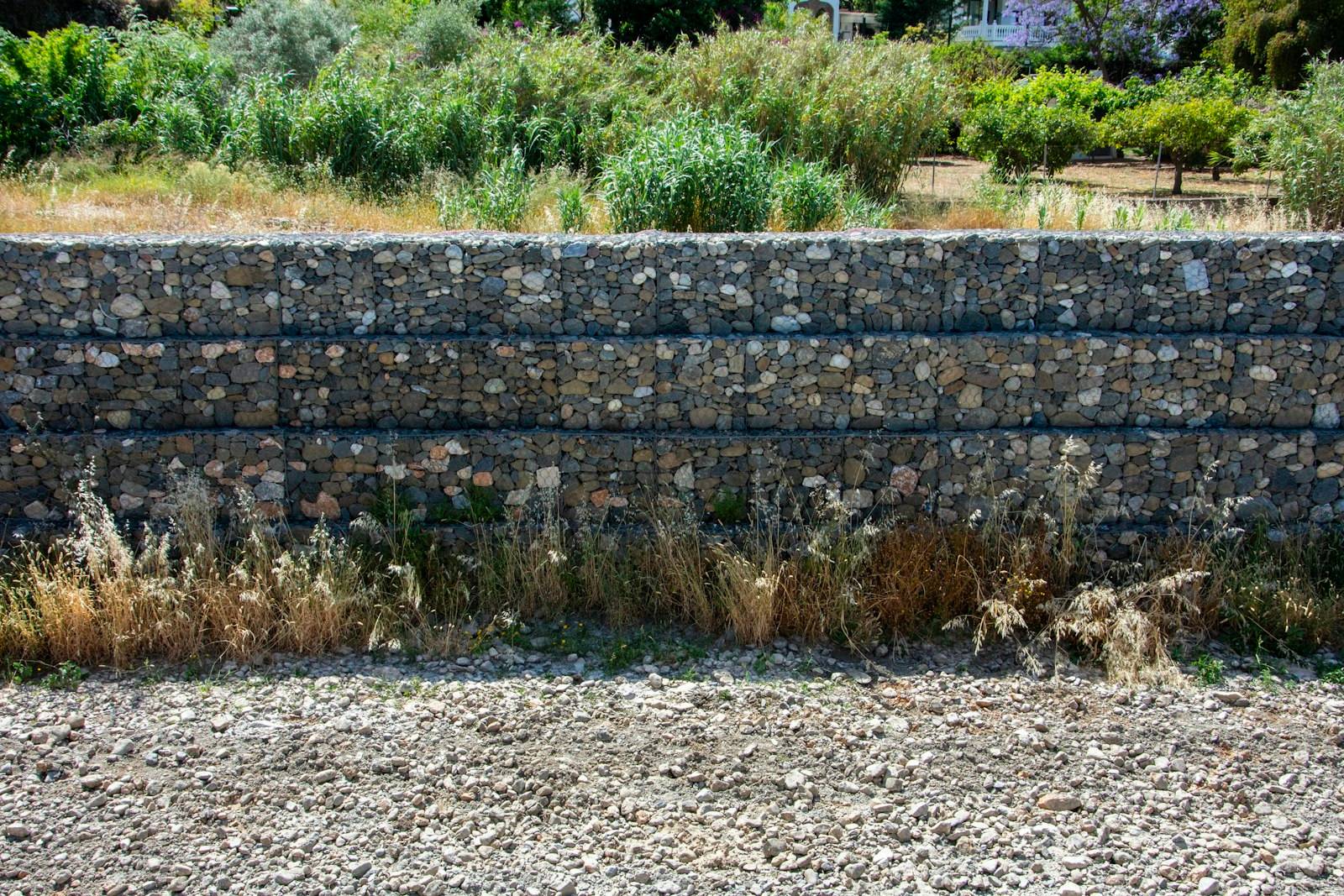
A gabion retaining wall uses rock-filled wire baskets assembled into a gravity structure that resists pressure from retained soil. Gabions can create a textured, natural-looking wall, but they are not simply decorative cages that can be stacked anywhere.
The rock provides weight; the wire mesh retains and contains the stone. A suitable design still needs a stable foundation, adequate wall geometry, appropriate baskets, drainage and attention to corrosion or erosion.
Gabion walls have been used in landscaping, roadwork and erosion-control projects. The Federal Highway Administration describes them as a form of modular gravity wall.
What Is a Gabion Wall Made From?
A typical gabion installation includes:
| Component | Role | Selection Issue |
|---|---|---|
| Wire mesh baskets | Contain rock and form wall units | Welded versus woven mesh, protective coating, design strength |
| Rock fill | Supplies weight and visible finish | Suitable size, durability, source and placement |
| Foundation/base | Supports the wall and limits settlement | Soil bearing, grade, preparation |
| Basket connections and bracing | Keep the units assembled as intended | Must match the chosen system |
| Backfill and filtering where required | Support retained soil and limit migration | Soil characteristics and site-specific design |
| Surface/subsurface water controls | Manage runoff and water pressure | Discharge location, groundwater, erosion risk |
Some gabion systems use welded wire baskets, while others use double-twisted woven mesh. These aren’t interchangeable products for all applications. The project design should specify the appropriate system and environment.
How Much Does a Gabion Retaining Wall Cost?
Published installed-price references for gabions vary widely because the rock, basket, wall size and installation conditions differ.
HomeGuide’s stone retaining wall guide gives broad gabion ranges by project type; its general retaining-wall material comparisons have described approximately $10–$40 per square foot installed for some gabion work.
Treat this as an early reference only, not a guaranteed national price for a retaining structure.
Actual costs depend on:
- Wire specification and protective coating.
- Stone supply, delivery and hand placement.
- Size, height, width and geometry required by the design.
- Excavation, foundation and site access.
- Appropriate backfill, filtering and drainage.
- Whether wall construction occurs near moving water or erosion.
- Permitting, engineering and restoration.
A rock basket bought online is not the same as a complete installed retaining wall.
See our retaining wall cost guide and cost calculator for general budgeting.
Are Gabion Retaining Walls Strong?
The wall’s performance depends on its designed mass, width, foundation, basket construction and site conditions. Gabion gravity structures can be engineered for substantial projects; they are not universally “weak” or “strong” just because the units are wire baskets.
The FHWA’s modular retaining-wall material explains that gabions rely on the weight of fill material within the structural modules.
As with other walls, the design must consider sliding, overturning, bearing and relevant loads.
Do Gabion Walls Need Drainage?
The open appearance of rock fill does not automatically solve every drainage issue.
Water needs a suitable path through and around the wall, and the design must prevent loss of retained fines, unmanaged runoff, erosion or scour.
Gabions placed near waterways have additional conditions that ordinary garden-wall examples don’t cover. FHWA hydraulic guidance notes the need to consider firm foundations, scour and appropriate details for streambank installations.
For homeowners, the important questions are where water comes from, whether it will carry soil away and where it discharges.
Read retaining wall drainage for a more detailed explanation.
Gabion Baskets: Corrosion and Service Life
Steel mesh can corrode. The rate depends on exposure, coating, water and soil conditions, damage and product selection.
A gabion system’s service life isn’t determined simply by saying it is “galvanised”. Specialist manufacturers publish different basket products and protective coatings for different environments. For instance, Maccaferri’s published residential-project case study describes selecting additional coating protection for a salt-exposed project.
That is one engineered project, not a promise that a garden gabion will last the same number of years.
Ask for the exact basket product and its suitability for your environment.
Advantages and Limitations
Potential benefits: Textured stone finish, modular construction, potential use of locally available suitable rock, and flexibility in designed layouts.
Potential limitations: Required wall width may reduce usable space; heavy rock still needs handling; corrosion protection matters; fine soil can escape without suitable filtering; and baskets with inadequate connections, stone selection or support can distort.
Visual permeability should not be confused with permission to omit engineering.
Gabion vs. Stone or Concrete Block
A gabion is a rock-in-mesh gravity system. A natural stone gravity wall uses carefully arranged stone without wire containment; a segmental concrete block wall relies on manufactured units and sometimes soil reinforcement.
Choose based on whole-wall design, space, exposure, finished appearance and installed cost.
See natural stone retaining walls and concrete block retaining walls for those alternatives.
What to Ask a Gabion Contractor
- Is this a retaining wall or a decorative garden screen?
- What engineering or design basis governs wall width and height?
- Which mesh system, coating and connections are specified?
- Where is the rock sourced and what quality/size is required?
- What foundation and settlement considerations apply?
- How will soil fines and surface runoff be managed?
- Where will collected or concentrated water go?
- What are the expected inspection and maintenance needs?
- Can you show similar installed retaining-wall projects?
- Who is responsible for permits and professional approvals if required?
Gabion Retaining Wall FAQs
Do gabion retaining walls need concrete foundations?
They need suitable support, but a conventional cast-in-place concrete footing isn’t automatically required in every design. The engineer or system designer determines foundation needs.
Do gabion walls rust?
Steel baskets can corrode. Coatings and environmental exposure matter, so the product and design should match the intended conditions.
Can you build a gabion wall against a creek?
Waterway projects need specialist assessment of scour, erosion, environmental rules and hydraulic forces. A garden-basket guide is not a substitute.
Are gabion walls cheaper than concrete?
Sometimes, particularly where local stone and the right system are available. But a wide gravity wall, baskets, rock, equipment and foundation work can change the economics substantially.
Can a damaged basket be repaired?
Sometimes; the safe method depends on what has failed, whether rock can be retained during work and the system’s designed connections. Seek professional advice for a retaining structure.
Compare Gabion Specialists
Use actual wall project references, not generic decorative basket installation, when evaluating providers.
RetainingWallGuide is an information resource and contractor directory, not a retaining-wall designer or installer.
Sources and Method
- Federal Highway Administration — Highway Materials Engineering Workbook
- FHWA — Design of Riprap Revetments
- HomeGuide — Stone Retaining Wall Costs
- Maccaferri — Gabion Wall, Blackburn Housing Development
Sources reviewed October 14, 2026. Cost benchmarks are broad published estimates, and the manufacturer example is not original RetainingWallGuide research.
Review status: the technical sections of this guide have not yet been reviewed by a qualified professional. We’ll name the reviewer and their qualifications here once that review is complete. See our editorial policy.